
ELEVATING THE ART OF AERIAL
Some of aerial cinematography’s key providers share their perspectives on the state of the industry, the opportunities, the challenges, and what’s coming next.
Aerial film companies in 2025 are navigating a market that’s busy, fragmented and changing fast, but are also more technically ambitious, creative and narratively integrated than ever.
“We’ve been back-to-back on some lovely TV dramas and action feature films coming out this year and next,” says Isabel Wells, head of operations at Flying Pictures. “We’ve had the pleasure of working with the fantastic team behind The Walking Dead: Daryl Dixon, supporting their VFX work across various UK locations while their main unit continues production in Europe.
“We started 2025 running with a great feature film that reunited us with a director, DP and VFX supervisor we’ve collaborated with for many years. That long-standing relationship has fostered a deep level of trust and confidence in our team… we’re fully embedded in the heart of the action, not just capturing the general views, but contributing directly to the storytelling through dynamic and immersive aerial shots, all while maintaining the highest safety standards.”
This reflects a wider shift in how aerial units are integrated into storytelling. “We start working with productions early, working with cinematographers and VFX, to use drones for interior work in scenes, as well as stunts, making it increasingly creative,” says The Helicopter Girls (THG) co-founder and CEO, Emma Boswell. “As a specialist unit, we’re lucky; whatever is shooting, there’s demand for our expertise. As well as UK dramas, we worked on Paddington in Peru through the strikes, and Matthew Vaughn’s [working title] Stuntnuts. The big American productions took a while to come back after the strikes. Now things feel solid again, almost back to post-Covid levels.”
“Compared to the period during the strikes, which was a struggle for most people, things are improving,” agrees Dani Rose, director of CineAero and CineArray. “There’s definitely more work around, but it’s still competitive. Everyone is vying for the same projects.”
Rose feels the industry has changed: “It’s not as predictable as it used to be. Productions are looking further afield for the best service and price, so contracts are open to more competition. It means more opportunities, but also more uncertainty.”
“We’re seeing a bit of a divide on requirements at the moment,” says Phil Arntz, aerial DP at The Aerial Film Company (AFC). “Some productions are leaning heavily into aerial content, making it a core part of the storytelling rather than an add-on. These sequences are often narrative-driven, tightly choreographed, and embedded in the story, as they feature heavily on aerial elements. On the other hand, we also see productions being more selective, using aerials for very specific beats. What’s encouraging is that when aerials are used, they’re increasingly treated as storytelling tools, not just establishing shots.”
“The market has certainly picked up over the last few months and we’re seeing new productions coming online all the time,” agrees John Marzano, Assoc. BSC, CEO and aerial DP of Marzano Films (MFL).
Up and up
Helicopter Film Services (HFS) has seen aerial work increase in variety, such as growing demand for virtual production and the large-screen immersive market. “We’re being asked to fly single-camera, very large sensor, wide-lens setups,” says CEO and aerial DP, Jeremy Braben, Assoc. BSC. “Previously, this was done with multi-camera arrays, but it’s simpler handling one large data stream than six.”
But he says arrays still offer key benefits. “Recently, for an independent film, we built a 360-degree array with six RED Raptors and Zeiss Primes in a ring. Even though a 360-degree, six-camera array is not cheap, it gave production huge scope downstream. It allowed for multiple background options in a single pass, giving VFX the ability to move around any of those six cameras where everything’s moving in the same way, the clouds are moving in the same space through the sky, the lighting is the same… so when [VFX] move around a character to look in the other direction, it’s all absolutely correct. It saved a lot of a lot of time and a lot of money.”
Drones take off
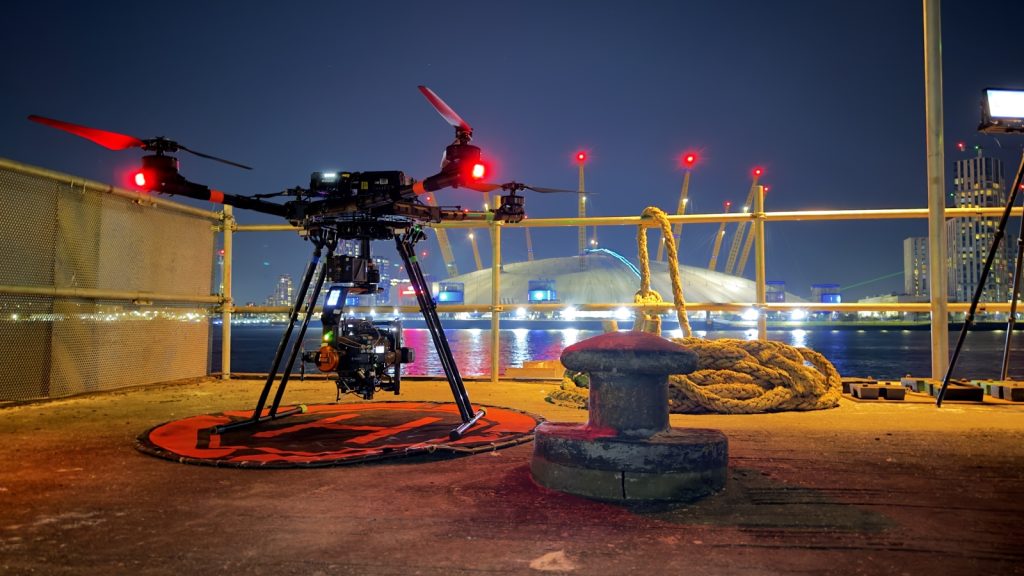
“On House of the Dragon series two we used drones to simulate the dragon’s eyeline and to get shots where other aerial platforms couldn’t go,” says Braben. Drones offer a more fluid, first-person perspective, similar to a Steadicam in the sky. We’re getting more requests for FPV (first-person view) drones, fast and flown by skilled pilots, often without a camera operator. Initially, requests were for very kinetic shots, but now there’s a more mature approach, using FPVs as a tool for specific unique shots.”
“The majority of the aerial requirement this year has been for drones,” says Marzano, who says MFL’s Inspire 3 fleet has been busy, particularly on projects like Mobland. “The VFX department was highly impressed with the quality and accuracy of the system’s stabilisation,” he adds. “These ‘cinema drones’ allow for closer interaction with cast on set and have enabled production teams to look at a broader, more challenging range of shots that integrate extremely well with traditional cranes and dollies.
Precision is now a major selling point. “Several VFX departments, notably on Paddington in Peru, have taken advantage of the RTK system that is part of the DJI Inspire 3 drone architecture,” Marzano explains. “The integration of this differential GPS allows the capture of extremely accurate and repeatable 3D moves.”
Marzano Films’ heavy-lift Freefly Alta X has been used with custom payloads such as light arrays for DPs, the team is also continuing to develop new payload setups for its Movi Pro and Ronin gimbals. Both its Alta X and Alta 8 have recently been upgraded alongside a full refresh of the FPV fleet, improving stability and manoeuvrability in tight spaces.
As well as heavy-lift drone work, innovative FPV is a specialism for The Helicopter Girls. For example, a racing sequence for the new Downton Abbey feature saw an FPV flying a RED Raptor with a 100mm lens, tracking race horses as they galloped.
“The shots are astounding; you’d never guess it was a drone as it feels so smooth and immersive; FPV has come into its own,” says co-founder Katya Nelhams-Wright. “We’ve used FPVs on productions like Bridgerton and The Rings of Power. It proves you can use this tech for all types of shots, not only fast-moving stunt work.”
“On a recent feature, we used FPV to dive dynamically inside studios and around complex sets, working safely around cast, stunt performers and wire work,” says Boswell. Ace FPV pilot and engineer Luke Bannister enabled that work, tuning a fully caged drone to fly cinema payloads with lens control. “It’s not an easy feat to be able to balance and tune the Raptor or Komodo X payloads we carry with full lens control capability on a small form gimbal, so it’s still relatively unique,” Boswell adds.
“We’re frequently asked to fly our Alta X heavy-lift drone, often paired with the Sony Venice 2, delivering top-tier cinematic results,” says Flying Pictures drone camera operator, James France. That said, the Inspire 3 has proven to be an incredibly reliable and versatile workhorse within our fleet. We’ve seen a clear shift toward lighter drones and more compact camera systems, which allows us to carry an increasingly wide range of cameras within the drone’s payload capacity, often matching the exact setups used by the main unit. As a result, we’re able to deliver precisely what directors and DPs are looking for, without compromising on technical specifications or creative intent.”
Chop and change
“There are simply fewer productions needing large-scale aerial filming,” notes Braben. “While drone work is still common, helicopter-based filming is usually the first to be cut when budgets are tight.”
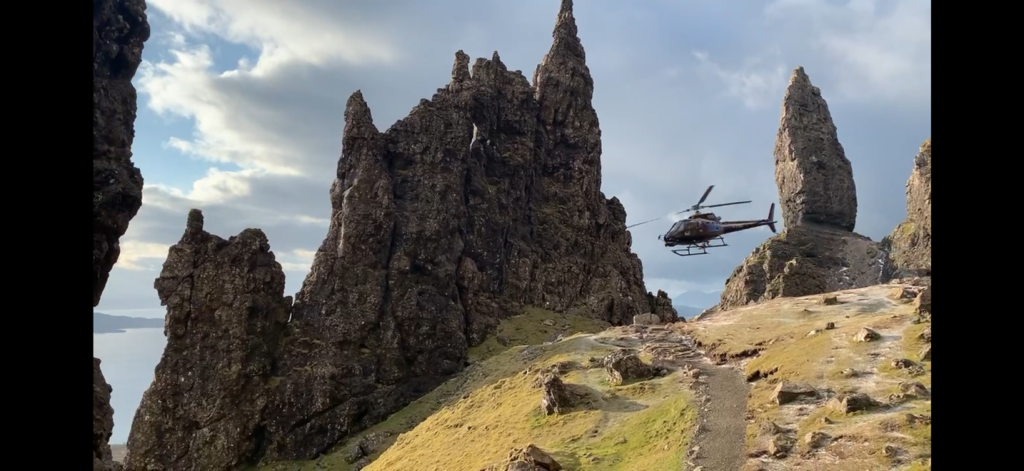
However, he and others stress that helicopters remain essential for certain locations and types of shots. “Helicopters can fly in a greater variety of weather conditions, as well as higher and further than drones. And for background or VFX plates, helicopters are ideal for covering large territories, something drones can’t do as efficiently. For How To Train Your Dragon we shot in places like Skye, Iceland, and the Faroe Islands. These aren’t very drone-friendly locations; helicopters were essential.”
Helicopters also outperform drones in endurance and speed. “A multi-location task might take minutes or hours between locations in a helicopter, rather than days for a drone,” Braben adds. “There’s something distinctive about a helicopter shot… but an FPV drone shot is also very different!”
“Helicopter work is still requested regularly,” says Marzano. “Our Mini Eclipse system carried the Sony Venice II and the Premista 28:100 for the Mobland day and night aerial imagery over central London, while our Eclipse XL helicopter system spent several days in Iceland for Dune: Messiah with an IMAX camera and 1000ft magazines.”
“Helicopters remain indispensable for dynamic work, high altitude, congested areas and enhanced endurance, says Phil Arntz. “Increasingly, we’re collaborating with VFX teams to supply real-world aerial plates for volume stages or compositing. This hybrid approach is only going to grow. The role of helicopters is evolving, but far from diminishing, they’re becoming even more specialised and integrated into modern workflows.”
AFC is “doubling down” on manned aviation and high-performance platforms, currently going through the latter stages of certification of its Pilatus PC-9, a high-speed fixed-wing camera aircraft. “It opens up a whole new world for capturing fast-action sequences from the air,” says Arntz. “We’re actively working with the CAA to allow some exciting new equipment to be used in the UK which will increase our picture-aircraft capabilities in the future.”
Tech tools up
“My company is heavily focused on R&D and specialist technology, and that’s kept us busy over the last four or five years,” says Rose. “We have a proven track record of delivering bespoke solutions, not just saying we can do it, but actually building and deploying the technology on major productions.
“Our sister company, CineArray, has been doing very well on the VFX side,” adds Rose, highlighting a Shotover-mounted camera rig he recently designed which can potentially offer three arrays in one to help VFX teams maximise aerial shoot days. “It could be a three-camera or a five-camera array, and a three-plus-one, which combines the array with a single hero camera: you can capture your array plates, and also the GVs or beauty shots at the same time,” explains Rose who has designed new plates, new electronics, and new power management for the system. “You take out the bottom tray and put the single camera in, and it becomes the other system. It cuts your downtime – no need to re-rig or swap heads. Just shoot and go”
Like the rest of the film industry, AI and automation are integrating into aerial work.
“We are increasingly utilising AI as part of our cutting edge technological developmental program and are actively exploring the use of AI for advanced setup of flight and safety characteristics of the aircraft we fly,” says Marzano.
“AI will only enhance what the drones can do over the next few years, rather than diminish what we’re doing on set,” says Katya Nelhams-Wright, who highlights THG’s development of Drone MoCo, a system that can take a motion track from any camera head and replicate that move on a drone anywhere in the world. Originally built during Paddington in Peru to overcome GPS limitations in the Amazon, the system allowed precise aerial plates shot in Colombia to be recreated on a UK backlot, even given that orientation and location had shifted entirely. “This is very different to the Inspire 3’s ability to replicate a flight path in the same location repeatedly,” notes Boswell. “What we’re pioneering is true drone motion control.”
Another major innovation is the Hydra, a heavy-lift drone designed for wet weather filming. Based on Dutch Navy technology and tested to withstand 10mm of rain per hour, it can legally fly with payloads up to 18kg in rain, a first for the UK. Custom rainproof bags have been designed by Nelhams-Wright for each payload, ensuring every component stays dry and operational. The creative possibilities extend beyond bad weather – Boswell says that at Hydra’s launch at BSC Expo 2025, cinematographers were excited about the creative possibilities of its use with rain machines.
“As technology advances, sensors get bigger and bodies smaller, making unique rigs easier to build,” says Braben. As well as adapting high-resolution stills cameras from the 1980s for helicopter use in a technically demanding art project, HFS is also looking at advancements in how video is transmitted from helicopters to the ground. “We’ve been working with Starlink to send footage via satellite, allowing remote viewing anywhere, even in LA.”
On-screen presence
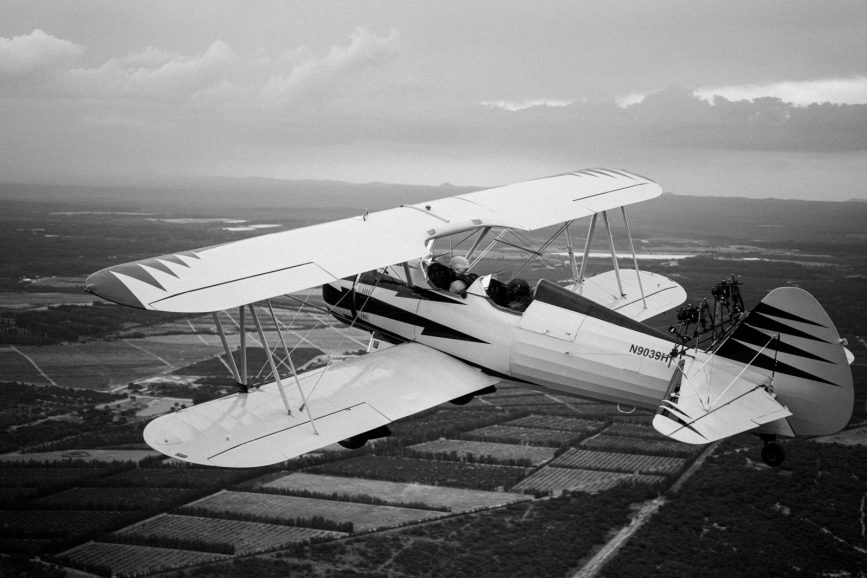
Phil Arntz describes AFC’s recent work on Mission: Impossible – The Final Reckoning and the upcoming F1 film as the “cutting edge of aerial cinematography”. “Both demanded extreme precision, complex multinational coordination, and flying that pushed the limits of what’s possible, whether it’s threading biplanes through canyons or flying inches from F1 cars on circuits around the world,” he explains. “These projects involved complex permissions, multiple aircraft, low-level operations, air-to-air coordination and a strong working relationship with every department.”
The MI franchise has also been a major focus for Dani Rose and his companies, including designing the bodycam system for the skydiving sequences, the array system that went on the motorbike for the ramp stunt, and a lot of the drone work in the 2023 film.
“For Mission: Impossible – The Final Reckoning, I designed the camera mount systems for the aeroplanes used in the big stunts, handling everything from camera integration to power management and communications,” adds Rose. “Each aeroplane was unique, so every mounting system had to be custom-built. We ended up with 52 different mounting options per airframe, all built to aviation standards and tested rigorously.”
Jurassic World Rebirth saw Marzano Films’ Inspire 3 drones deployed overseas to Thailand and Malta, and later, Sky Elstree backlot sets. “The range of shots we provided was extensive and included high octane action shots for both main and second units, and many VFX plates,” says Marzano. “In Malta we also brought in a camera helicopter with our Mini Eclipse system for a few days of exciting high-speed photography, chasing fast patrol boats and ribs off the coast. We went straight onto Mobland, which involved some tricky shots with close interaction with cast, action vehicles and sets, all made more feasible with the smaller cinema drones.”
The Helicopter Girls’ technical expertise was crucial in Adolescence, where each episode was filmed as a single take. “They wanted to hand off the DJI Ronin 4D from the ground operator to the drone, and then back to handheld,” explains Nelhams-Wright. Chief pilot Pete Ayriss modified the Griphaus Shotdock to make the mid-shot transfer work, with in-house manufacturing allowing rapid prototyping and testing. “It was technically challenging… we had to make sure the whole ecosystem worked – signal, control links, everything – since it was the last shot of that episode, and we didn’t want to lose signal right at the end.”
Industry challenges
Previous regulatory concerns have eased as the UK adopts SORA, a European-aligned framework. “The new regulation is a different methodology; it’s administrative, not prohibitive,” says Boswell. “Productions understand the need for safety, especially when operating over crowds or in London.”
Still, safety risks remain. “There are more drone operators putting themselves forward as legitimate entities but lack the experience and expertise to safely deliver quality,” says Marzano. He points out that if an operator breaks the law and an incident happens, “it’s not just the operator that finds themselves under scrutiny, it’s also the production company and even the studios.”
“Too often we’re brought in very late in the process, sometimes with just days to secure low-level permissions, or to engineer complex stunt scenarios,” says Arntz. “While we pride ourselves on solving these challenges quickly, early engagement allows for better safety planning, more creative options, and smoother integration with VFX and second unit work.”
Blue sky thinking is definitely encouraged by all these aerial filming providers. “Don’t limit your vision. The earlier we talk, the more we can make happen,” says Arntz. “Dare to dream big.”
Spotlight – aerial companies
The Aerial Film Company
At The Aerial Film Company, we understand the demanding, fast-moving nature of production—schedules shift, ideas evolve, and there’s never enough time in the day. That’s why we offer a fully in-house, turn-key aerial filming service designed to simplify the process for DPs, directors, producers and production managers.
We own and operate everything: helicopters, planes, gyrostabilised camera systems, cameras, lenses, arrays and back it all up with experienced crew. No sub-rentals. No waiting on third parties. Just seamless coordination, one point of contact, and total control from prep to post.
Our background in both film and aviation means we speak your language on set, and ours in the air. Whether it’s close proximity air-to-air, low-level canyon flying, or operating over congested areas, we deliver the results with maximum efficiency and minimum fuss.
Recent productions include Mission: Impossible – The Final Reckoning, F1, Day of the Jackal, The Immortal Man, Supergirl, Hijack Season 2, The Agency, The Cleaner and Apex.
CineAero
CineAero stands as the premier provider of professional aerial filming services, setting the industry standard with our innovative approach and commitment to excellence. From drones, helicopters and aeroplanes to bespoke camera solutions used to capture high octane stunts to multi-camera arrays, CineAero is equipped to meet all your aerial filming needs with unmatched precision and expertise. The team’s passion for excellence ensures that every project receives the highest level of attention and care, making your aerial footage truly extraordinary.
Upcoming projects include: The Thursday Murder Club; Masters of the Universe; Jack Ryan; The Conjuring: Last Rites; and Steve.
Previous projects include: F1, Mission: Impossible – Dead Reckoning Part One; Mission: Impossible – The Final Reckoning; Deadpool & Wolverine; Kraven the Hunter; Heart of Stone; and The Flash.
Flying Pictures
Working alongside director Ric Roman Waugh and director of photography Martin Ahlgren, the Flying Pictures drone unit, led by aerial camera James France as operator, contributed to the highly anticipated sequel to Gerard Butler’s 2020 hit movie, Greenland.
Greenland 2: Migration, set for release later this year, was partially filmed in the UK and Iceland. Flying Pictures provided both heavy-lift and light-lift drones for various day and night operations across multiple locations.
A notable aspect of working with Ric Roman Waugh is his penchant for large-scale explosion sequences, and Greenland 2: Migration (courtesy of Mr. Flowers) was no exception. Amidst challenging conditions “in the trenches,” James France and world-class pilot Wesley Green utilised an Inspire 3, a Heavylight camera drone, and a DMX-controlled light drone. The light drone enabled Gaffer Charley Cox to meticulously replicate realistic flare shadows as the action unfolded below.
Flying Pictures prides itself on its flexibility and close collaboration with various departments. Greenland 2: Migration exemplified this, allowing the drone department to seamlessly integrate with VFX supervisor Marc Massicotes’ team. This collaboration was crucial in building the film’s world, with Flying Pictures providing 2nd unit assets, stunt sequences, and photogrammetry for a world we eagerly await revisiting!
Helicopter Film Services
Helicopter Film Services brings ever-better visual effects possibilities to makers of VFX-laden productions. Aerial cinematographer, Jeremy Braben Assoc. BSC, explains: “We always aim to go one step beyond what’s been done before, giving producers and directors more effective tools for the job. New battery and drone technology allow larger camera and sensor packages to be flown for longer, with more accuracy and seamless integration into production.”
Having helicopter and drone services means HFS can offer un-biased, knowledgeable advice: “We pride ourselves on being flexible, and listening closely to what production needs.” It also offers enormous choice: “We fly large format IMAX & 65, and our 3- and 6-camera arrays such as our Typhon – and our 360º 6-camera array – with ARRI Alexa or RED cameras.”
Recent productions include: How To Train your Dragon, Kraven The Hunter, Sonic The Hedgehog 3, Wicked, The Union, House Of The Dragon, Knives Out, Glass Onion: A Knives Out Mystery.
The Helicopter Girls
Early 2024, director of photography, Ben Smithard BSC, came to The Helicopter Girls with an idea of a shots he had in mind for a horse racing sequence for his upcoming feature, Downton Abbey – The Grand Finale.
For the race, the horses could only run a handful of times due to the ground conditions and fatigue so Smithard wanted as much coverage as possible. For the high wides of the crowd and stands, they flew the heavy lift drone with the Sony Venice and ARRI Signature Primes with full lens control to give as much flexibility as possible. He also wanted to get right in with the action so The Helicopter Girls built a bespoke FPV drone which was capable of flying a RED Raptor and 100mm CP3 with full lens control on a stabilised head. The drone is small and fast, meaning they could get close up, tracking with the horses as they ran. The resulting shots were intimate and explosive, and you feel you are right in the race.
Marzano Films
Jurassic World Rebirth, directed by Gareth Edwards (Rogue One, The Creator) and lit by John Mathieson BSC, has an all new cast lead by Scarlett Johansson. The characters have to survive the onslaught of hitherto unseen dinosaurs, all with ferocious appetites and bigger teeth!
Together with the production team, Marzano Films aerial coordinator, Jenni Saunders, orchestrated the permits and import licences for flight operations in both Thailand and Malta.
Marzano Films drone and helicopter Aerial Units, led by John Marzano Assoc. BSC, spent several weeks on location in Thailand and Malta as well as on the backlot at Sky Studios Elstree shooting live action and VFX elements.
For the drone sequences and VFX plates (orchestrated by David Vickery) they used two of their DJI Inspire 3 aircraft shooting in 8.1K Cinema DNG. The Inspire 3 proved its versatility when shooting in the tighter jungle locations of Thailand and over the backlot sets in Elstree.
For the helicopter work in Malta they used their Mini Eclipse system mounted to an AS350B3 helicopter. The camera choice here was a RED Weapon Monstro and a Premista 28:100 lens combination.